Ultra-fine and high-purity cleaningMaximum cleanliness – not just a cleaning process
Ecoclean. To secure a future-proof and competitive position in the market, numerous companies are restructuring their product ranges. The trend is towards sophisticated solutions for high-tech industries. This not only means higher demands on the precision of components, but also extremely strict specifications regarding particulate and film cleanliness, which must be achieved in a process-reliable, economical and sustainable manner. This requires a different approach to cleaning, a critical look at the entire production chain and manufacturing environment, and an experienced partner.
During industrial transformation, more and more companies are focusing on the manufacture of high-quality
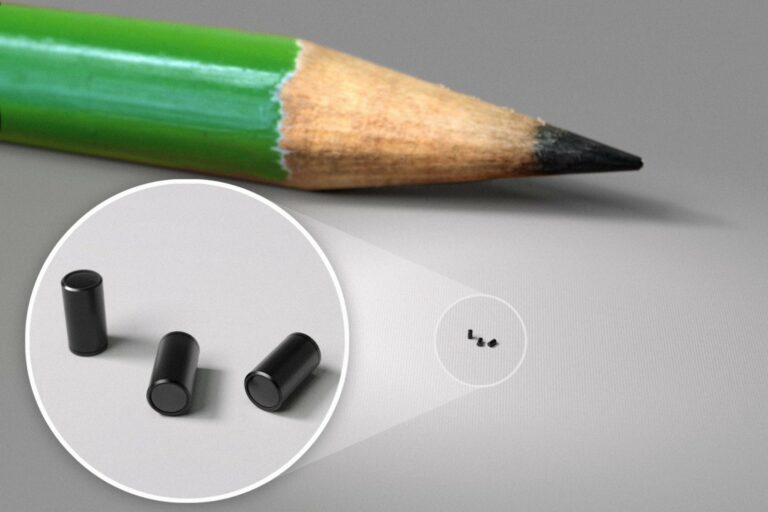
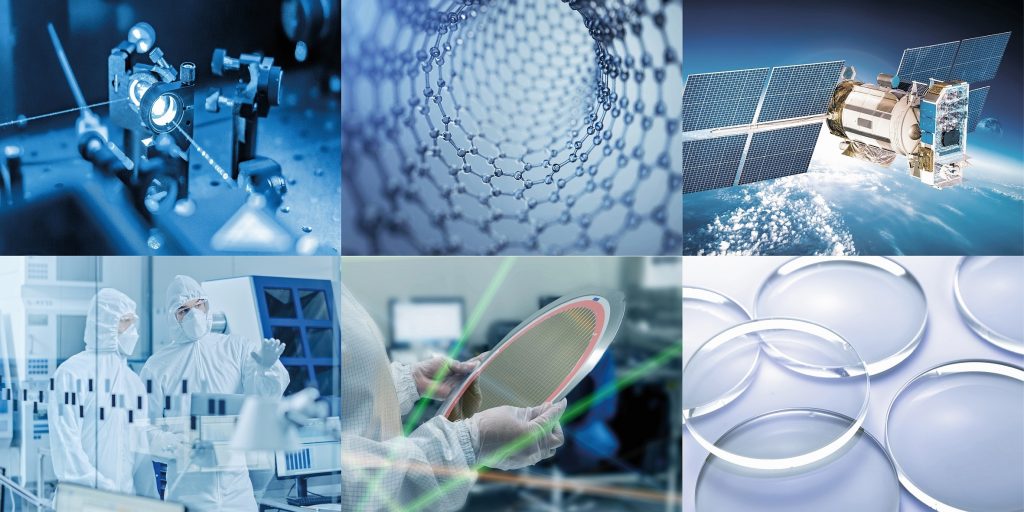
products and components with good margins. The focus is on high-tech industries that promise stable demand through growth in the future. The extremely high demands on manufacturing precision in these industrial sectors, such as the semiconductor supply industry, electronics manufacturing, e-mobility, the optical and optoelectronic industry, sensor technology, photonics, thin-film technology, vacuum, laser and analysis technology, and aerospace, include the cleanliness of components. This applies regardless of whether the components are barely visible electronic parts, millimeter-small connecting elements, precision optics or meter-sized structural components, and regardless of the materials from which they are
manufactured.
Defining cleanliness according to requirements
This trend poses challenging tasks for parts cleaning. Unlike conventional component cleaning, which usually involves removing large quantities of manufacturing residues such as chips and processing media, ultra-fine and high-purity cleaning is all about removing minimal residual contamination. The specifications for particulate cleanliness extend into the sub micrometer range. Depending on the industry, component and its application, film-like residual contamination, such as organic and inorganic residues, ionic residues and microorganism residues, must be removed in a process-reliable and reproducible manner down to nanometer levels. In high-purity applications, such as the manufacture of components for EUV lithography, so-called hydrogen-induced outgassing (HIO) substances must also be considered.
The requirements for particulate cleanliness to be met during cleaning are specified by the corresponding surface cleanliness class (ORK) according to EN ISO 14644-9 (SCP – surface cleanliness by particle concentration) or the corresponding VDI guideline 2083, sheet 9.1. Film-chemical, organic and inorganic surface cleanliness is usually defined by individual specifications or factory standards. In addition, outgassing rates may be evaluated using mass spectrometers.
These demanding tasks require a partner who, on the one hand, has comprehensive technological expertise and knowledge of applications and physical relationships. On the other hand, experience in this field of cleaning and appropriate test facilities for cleaning trials under production-related conditions should be available. As an experienced full-service provider of future-oriented and globally available solutions for ultrafine and high-purity cleaning, Ecoclean meets these requirements.